Marcus quit his Forum, not because it stopped working, but because he couldn’t find three hours a month to give it.
He’d been a member for four years. He credited the group with talking him out of a bad acquisition, coaching him through his first executive hire that didn’t work out, and giving him the one place in his life where nobody wanted anything from him except honesty. But his company had tripled in size over those four years, and his calendar hadn’t grown with it. Three hours, once a month, used to be easy to protect. Now it was the single hardest block to defend against board prep, a fundraise, and a kid’s travel soccer schedule that somehow required a group text thread with forty unread messages. He missed two meetings in a row, sent an apologetic email to his moderator, and quietly stopped showing up.
His moderator, to her credit, didn’t let him go that easily. She called Marcus and asked him: if the meeting were only two hours a month, would he be able to stay?
The three-hour Forum isn't sacred. It's just the default.
Most groups never question the length of their meeting because nobody taught them they could. The traditional three-hour agenda became the standard because it fits a full range of topics: business, personal, and family or community, plus room for two presentations and a break. That range is exactly what makes it valuable for most groups. It’s also exactly what makes it a hard sell for an executive whose calendar has gotten tighter every year they’ve been in the role.
That tightness isn’t just a Marcus problem. Harvard Business Review’s long-running research on executive time tracked how meeting load has climbed for decades, and it now sits at an average of roughly 23 hours a week for executives, more than double what executives spent in meetings back in the 1960s. When a Forum meeting has to compete against a calendar that’s already 23 hours deep in other people’s agendas, three hours starts to feel less like a monthly retreat and more like a tax. A two-hour, business-only version isn’t a lesser Forum. It’s a different tool for a specific kind of member and a specific kind of group.
There’s also a case for the format that has nothing to do with time and everything to do with focus. Karbon’s research on meeting length found that shrinking the time available for a topic forces hyper-focus instead of skimming the surface of many topics, and produces higher-quality outcomes as a result. By cutting everything that’s not business related, the conversations don’t get worse from losing an hour; they get sharper because everyone knows exactly why they’re in the room.
Trade-offs You Need To Accept Before You Try This
Fair warning that this agenda isn’t just a smaller version of your current Forum; it’s a different animal, and it comes with real trade-offs your group needs to discuss before adopting it.
You lose the personal and family layer entirely. The traditional Forum earns a lot of its psychological safety from the fact that members see each other as whole people, not just operators. A business-only meeting trims that down to “personal as it relates to business,” meaning a divorce, a health scare, or a family crisis only gets airtime if it’s actively affecting the member’s capacity to run their company. That’s a real loss, and groups that lean heavily on the personal and family sections for connection should think twice before cutting them.
Your group needs to be smaller. A traditional Forum comfortably runs seven to nine members because the three-hour window has room to absorb that many voices. A two-hour, business-only meeting doesn’t have that luxury, so six or seven members are the sweet spot, and eight should be treated as a hard ceiling. Bain’s research on decision-making groups found what they call the Rule of Seven: every person added to a group beyond seven people reduces decision effectiveness by roughly 10 percent. A tighter group isn’t a compromise here; it’s the whole point.
You lose the standalone Goals/Aims section. In the traditional flow, Goals gets its own block of time separate from the Monthly Update. In this format, the two get merged into a single business update and goals check-in, which means less dedicated space for group discussion of each person’s goals. If your group treats goal accountability as one of its highest-value sections, this merge will feel like a loss.
The 2-Hour Business-Only Agenda
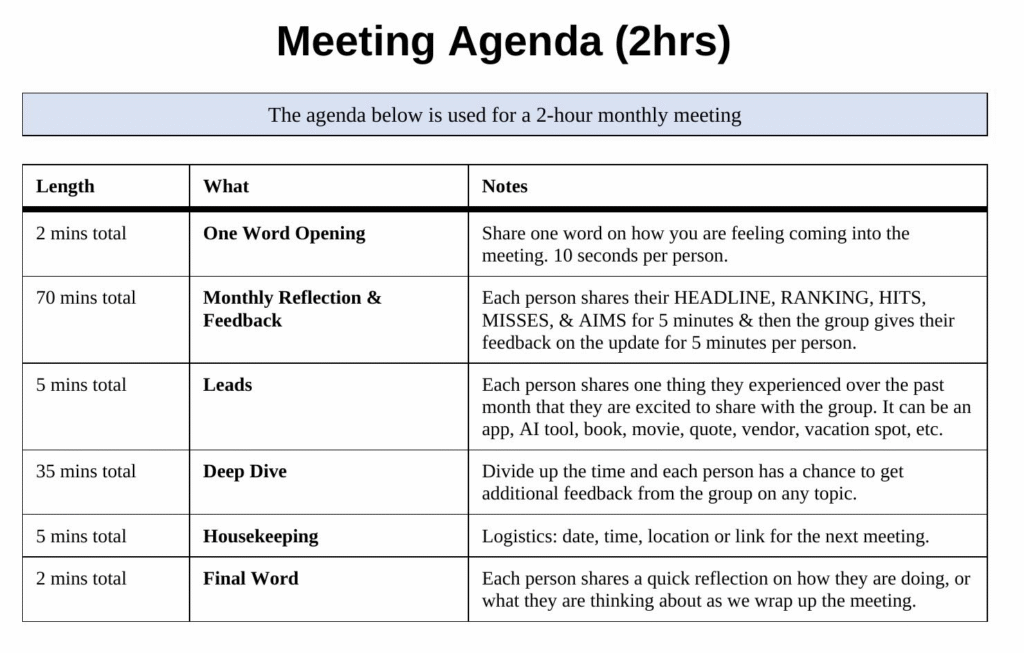
Here’s a full template for a two-hour, business-focused Forum meeting.
- One Word Opening (2 mins) – Each person shares one word on how they’re feeling coming into the meeting.
- Monthly Reflection & Feedback (70 mins) – Each person shares their Headline, Ranking, Hits, Misses, and Aims in 5 minutes, then the group gives feedback for 5 minutes per person.
- Leads (5 mins) – Each person shares something exciting from the past month: an app, book, vendor, vacation spot, or anything worth passing along.
- Deep Dive (35 mins) – Time is divided up so members can get focused feedback from the group on a specific topic.
- Housekeeping (5 mins) – Logistics for the next meeting: date, time, and location.
- Final Word (2 mins) – Each person shares a quick reflection on how they’re doing as the meeting wraps up.
The 2-Hour Business Only Monthly Update
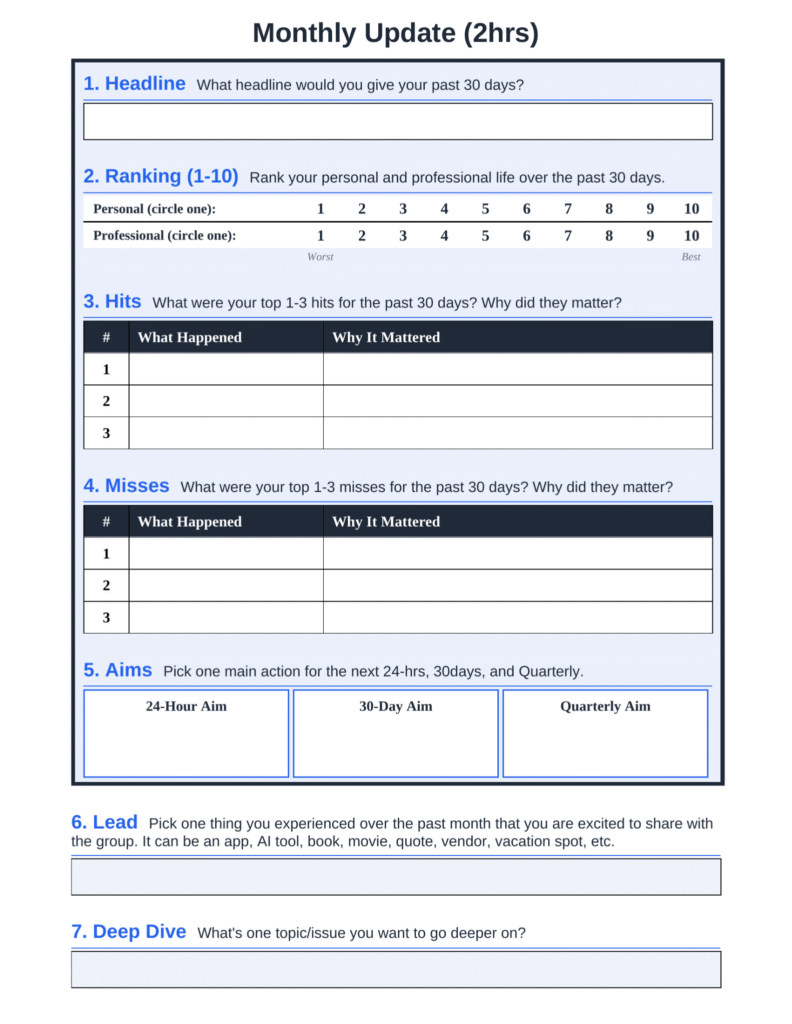
Here’s a full template for a two-hour, business-focused monthly update.
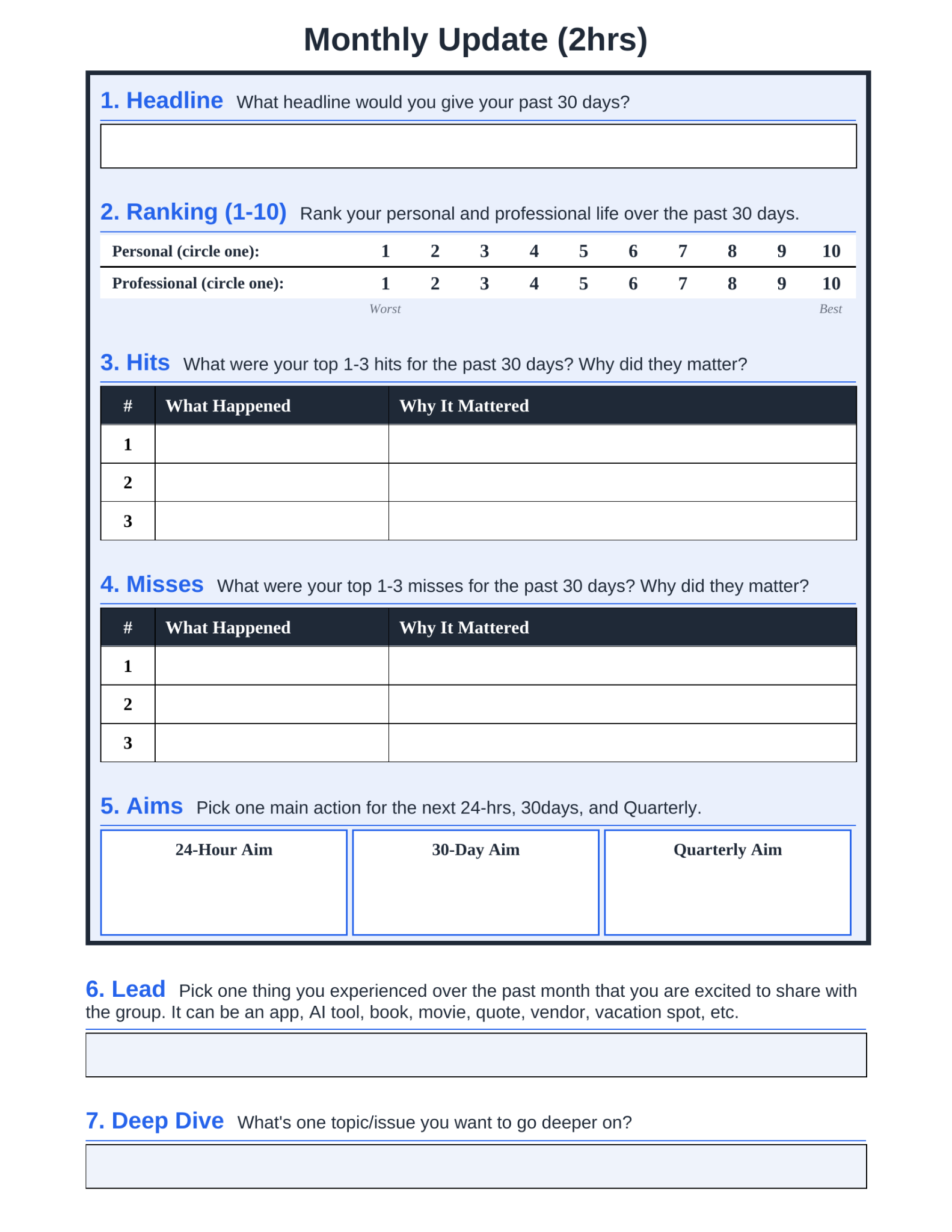
- Headline – What headline would you give your past 30 days?
- Ranking (1-10) – Rank your personal and professional life over the past 30 days.
- Hits – Your top 1-3 hits from the past 30 days, and why they mattered.
- Misses – Your top 1-3 misses from the past 30 days, and why they mattered.
- Aims – One main action for the next 24 hours, 30 days, and quarter.
- Lead – Something you experienced this month worth sharing with the group.
- Deep Dive – The topic or issue you want the group to help you go deeper on.
Final Thoughts
Shifting to this format can be a great option, but be honest with the group about what is lost.
- Without the family and community sections, connection has to happen somewhere else, whether that’s a dinner after the meeting or a group chat that actually gets used.
- There is no way to allow space for more than seven members. Eight max.
- Folding the Goals section into the Monthly Update is the easiest place for accountability to go soft without anyone noticing until three months of “not done” pile up.
The two-hour Forum may be less time, but it takes more intention to run well, and the groups that treat it that way are the ones who keep it.